

© 2026 Center for Digital Innovation and AI
À l’occasion de la Journée mondiale de la traduction 2026, l’École de traducteurs et d’interprètes de Beyrouth (ETIB) a organisé, le 22 septembre 2026 à l’Université Saint-Joseph de Beyrouth, une table ronde consacrée à l’innovation collaborative et à l’avenir de la formation dans les professions langagières. Un rendez-vous placé sous le signe d’une interrogation résolument actuelle : et si l’avenir de ces professions se construisait avec l’intelligence artificielle, et non contre elle ?
Le Centre de l’intelligence artificielle de l’USJ a pris part à cette réflexion à travers l’intervention de sa directrice, Madame Wadad Wazen Gergy, qui a présenté l’expérience de co-conception d’une plateforme d’auto-entraînement destinée aux apprentis-interprètes. Fruit d’une collaboration entre l’ETIB, le CINIA et l’ESIB, ce projet illustre une approche de l’innovation fondée sur le dialogue entre expertise métier, ingénierie et intelligence artificielle.
De l’idée au prototype : une innovation construite ensemble
Dans son intervention intitulée « Co-concevoir un outil d’auto-entraînement : de l’idée au prototype », Madame Wadad Wazen Gergy est revenue sur la genèse d’un projet qui, il y a moins d’un an, n’existait encore que sur papier. Dès ses débuts, l’enjeu dépassait le développement d’un nouvel outil d’intelligence artificielle. Il s’agissait de relever un défi plus fondamental : transformer une expertise métier forte en une solution technologique qui ait réellement du sens pour ses futurs utilisateurs. Cette démarche prend une résonance particulière à l’heure où l’essor de l’IA suscite de nombreuses interrogations sur l’avenir des métiers. Plutôt que de laisser la technologie redessiner de l’extérieur la profession d’interprète, le projet fait le choix d’associer les interprètes eux-mêmes à la conception des technologies appelées à transformer leurs pratiques.
Pour rendre l’idée tangible et ouvrir le dialogue, une première ébauche a rapidement été réalisée grâce au vibe coding. Il ne s’agissait pas encore de développer la solution définitive, mais de disposer d’un premier support concret pouvant être essayé, critiqué, déconstruit et repensé collectivement. C’est alors que plusieurs univers se sont rencontrés. L’ETIB a apporté son expertise du métier et sa connaissance des besoins des interprètes ; le CINIA a assuré le lien entre ces besoins, les possibilités technologiques et les différents acteurs du projet ; tandis que l’ESIB a mobilisé les compétences de ses étudiants ingénieurs, accompagnés par leurs enseignantes.
Ces derniers ont ainsi travaillé non pas sur un exercice fictif, mais sur un besoin réel de leur propre Université, à travers des projets de fin d’études, des jobs étudiants et des stages d’été rémunérés. Une dynamique qui traduit également une conviction portée par le CINIA: encourager l’innovation ne suffit pas ; l’institution doit créer les conditions permettant aux idées de devenir réalité.
Le prototype a ensuite évolué au fil d’un processus continu d’expérimentation. Les interprètes l’ont testé et challengé, les ingénieurs ont repris le développement, certaines limites ont été identifiées et de nouvelles pistes ont été explorées. Concevoir, tester, écouter, apprendre, améliorer : cette démarche itérative a progressivement fait du prototype un véritable espace de dialogue entre ceux qui connaissent le métier, ceux qui maîtrisent la technologie et ceux qui vivront directement les transformations qu’elle entraîne.
Du numérique au service de la pédagogie au numérique au service des humanités
Au-delà de la plateforme présentée, cette expérience reflète plus largement la vision du CINIA en matière de transformation numérique à l’Université Saint-Joseph de Beyrouth.
L’innovation technologique n’y est pas envisagée comme une succession de solutions conçues pour les utilisateurs, mais comme une transformation construite avec eux. Enseignants, étudiants, experts, services et gouvernance deviennent ainsi des acteurs à part entière du processus d’innovation. Le projet d’auto-entraînement pour les apprentis-interprètes en constitue une illustration concrète : une idée née chez une enseignante, développée avec des étudiants ingénieurs, mise à l’épreuve par des interprètes – enseignants et étudiants – et soutenue par l’institution. Il montre comment les compétences présentes au sein d’une même université peuvent se rencontrer pour répondre à des besoins réels et faire émerger de nouvelles pratiques.
Cette collaboration raconte aussi l’évolution de la mission portée par l’USJ dans le domaine du numérique. Comme l’a rappelé Mme Wadad Wazen Gergy lors de son intervention, l’UNTE avait placé « le numérique au service de la pédagogie ». Avec le CINIA, cette ambition s’élargit désormais pour devenir « le numérique au service des humanités ».
À travers cette table ronde, la Journée mondiale de la traduction 2026 a ainsi permis de déplacer le regard porté sur l’intelligence artificielle. La question n’est plus seulement de savoir comment l’IA transformera les professions langagières, mais aussi comment leurs professionnels peuvent participer activement à la conception des outils qui accompagneront cette transformation.
La plateforme d’auto-entraînement portée par l’ETIB, le CINIA et l’ESIB en offre une illustration concrète : l’avenir ne se construit pas en opposant expertise humaine et technologie, mais en créant les conditions pour qu’elles évoluent ensemble.
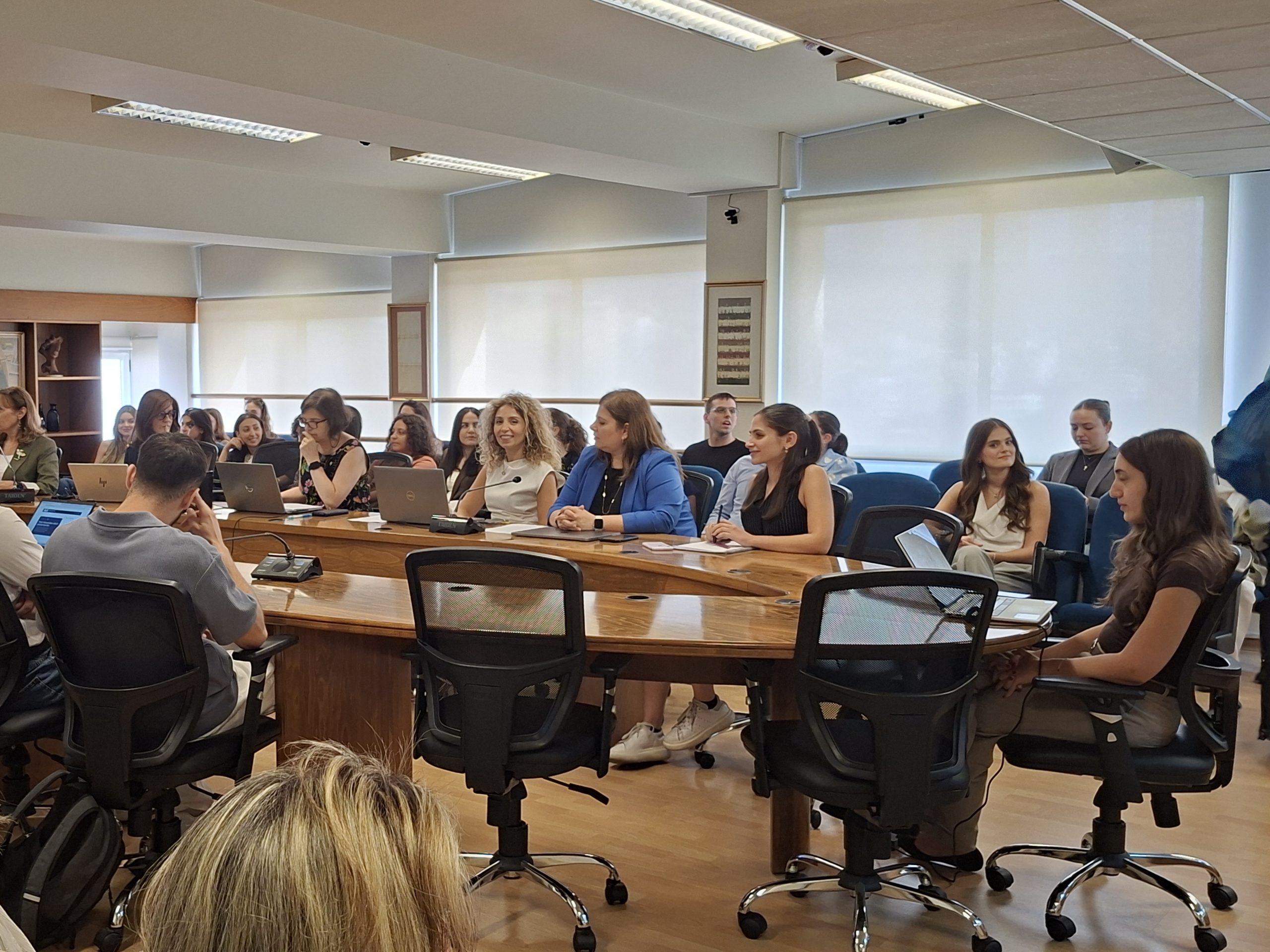
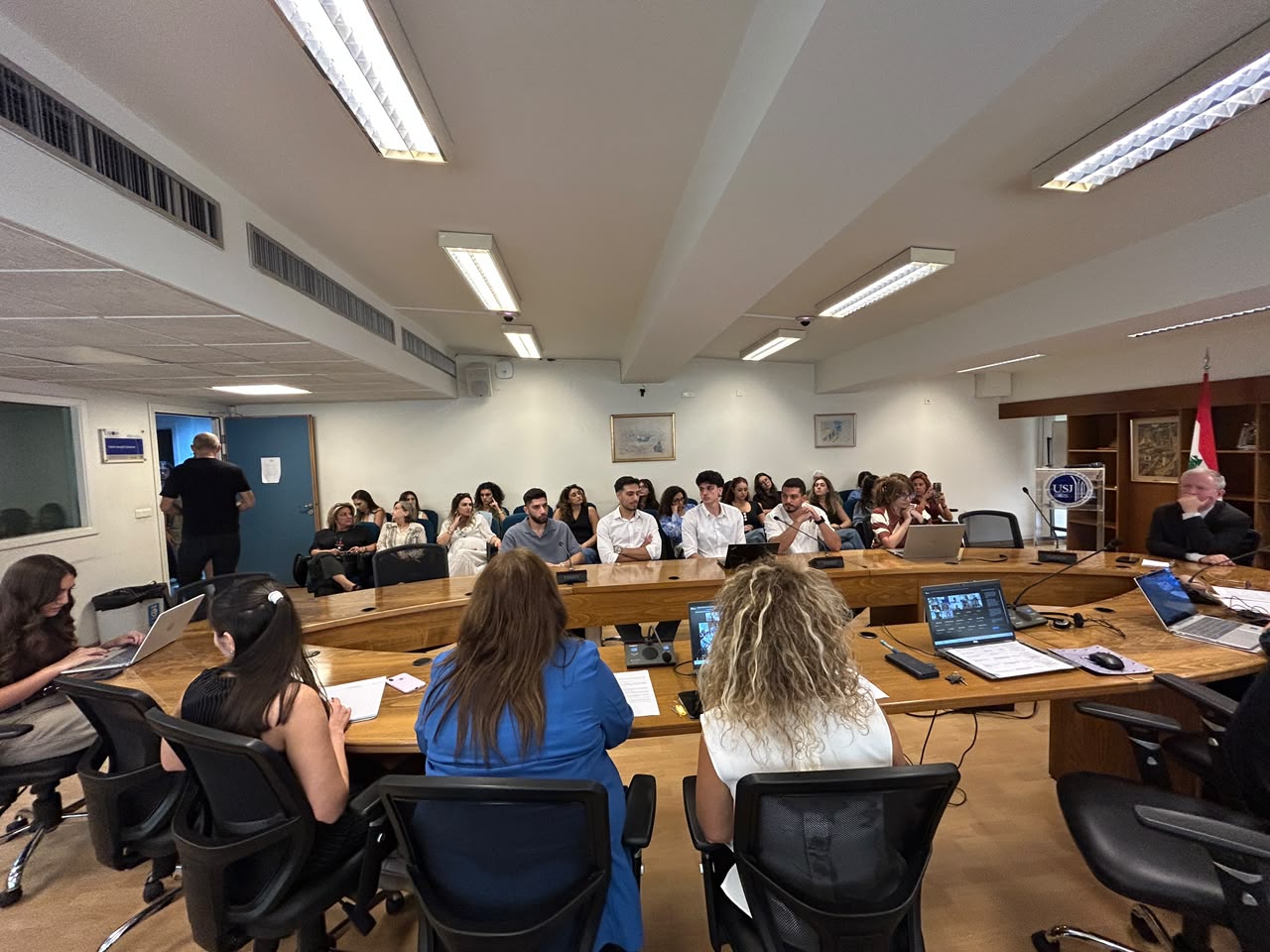
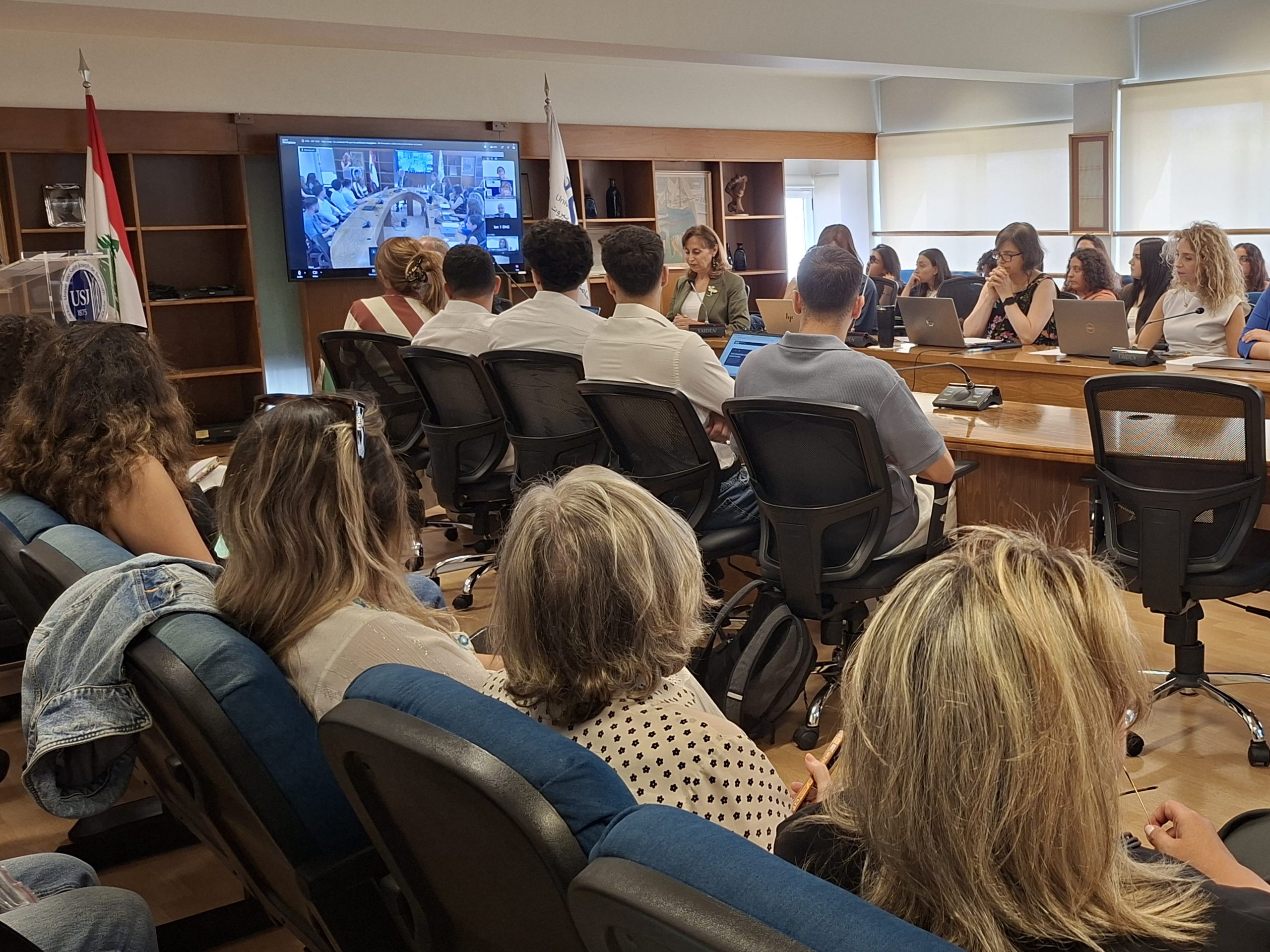
On the occasion of International Translation Day 2026, the School of Translators and Interpreters of Beirut (ETIB) organized a roundtable discussion on September 22, 2026, at Saint Joseph University of Beirut, focusing on collaborative innovation and the future of education and training in the language professions. The event revolved around a particularly timely question: What if the future of these professions were built with artificial intelligence rather than against it?
The USJ Center for Artificial Intelligence (CINIA) contributed to this discussion through the participation of its Director, Mrs. Wadad Wazen Gergy, who presented the experience of co-designing a self-training platform for trainee interpreters. Developed through a collaboration between ETIB, CINIA, and ESIB, the project illustrates an approach to innovation grounded in dialogue between professional expertise, engineering, and artificial intelligence.
From Idea to Prototype: Building Innovation Together
In her presentation entitled “Co-designing a Self-Training Tool: From Idea to Prototype,” Mrs. Wadad Wazen Gergy reflected on the origins of a project that, less than a year ago, existed only on paper. From the outset, the challenge went beyond developing a new artificial intelligence tool. It involved addressing a more fundamental question: how can strong professional expertise be transformed into a technological solution that is genuinely meaningful to its future users? This approach is particularly relevant at a time when the rapid development of AI is raising numerous questions about the future of professions. Rather than allowing technology to reshape the interpreting profession from the outside, the project seeks to involve interpreters themselves in designing the technologies that will transform their practices.
To make the idea tangible and initiate dialogue, a first draft was rapidly created using vibe coding. The aim was not yet to develop the final solution, but to provide a concrete starting point that could be tested, critiqued, deconstructed, and collectively reimagined. This was when several worlds began to come together. ETIB contributed its professional expertise and in-depth understanding of interpreters’ needs; CINIA served as the bridge between these needs, technological possibilities, and the various stakeholders involved in the project; while ESIB mobilized the skills of its engineering students, supported and supervised by their faculty members.
Rather than working on a hypothetical exercise, these students were able to apply their skills to a real need within their own University through final-year projects, student jobs, and paid summer internships. This dynamic also reflects a conviction strongly upheld by CINIA: encouraging innovation is not enough; an institution must also create the conditions that enable ideas to become reality.
The prototype subsequently evolved through a continuous process of experimentation. Interpreters tested and challenged it, engineers resumed development, limitations were identified, and new approaches were explored. Design, test, listen, learn, improve: this iterative process gradually transformed the prototype into a genuine space for dialogue between those who know the profession, those who master the technology, and those who will directly experience the transformations it brings.
From Digital Technology Serving Education to Digital Technology Serving the Humanities
Beyond the platform itself, this experience more broadly reflects CINIA’s vision of digital transformation at Saint Joseph University of Beirut.
Technological innovation is not viewed as a succession of solutions designed for users, but rather as a transformation built with them. Faculty members, students, experts, administrative services, and university governance thus become full participants in the innovation process. The self-training project for trainee interpreters provides a concrete illustration of this approach: an idea initiated by a faculty member, developed with engineering students, tested by interpreters—both faculty members and students—and supported by the institution. It demonstrates how expertise from across the same university can come together to address real needs and foster new practices.
This collaboration also reflects the evolution of USJ’s mission in the digital field. As Mrs. Wadad Wazen Gergy recalled during her presentation, UNTE had championed the principle of “digital technology serving education.” With CINIA, this ambition is now being broadened to embrace “digital technology serving the humanities.”
Through this roundtable discussion, International Translation Day 2026 thus offered an opportunity to shift the perspective on artificial intelligence. The question is no longer solely how AI will transform the language professions, but also how language professionals themselves can actively participate in designing the tools that will accompany this transformation.
The self-training platform developed by ETIB, CINIA, and ESIB provides a concrete example of this vision: the future is not built by setting human expertise against technology, but by creating the conditions for them to evolve together.
Leave a Reply Cancel reply


CINIA is located on the 7th floor of the USJ Human Sciences Campus on Damascus Street in Beirut.
Do not hesitate to contact us at cinia@usj.edu.lb
or call us on +961 1 421 000 extension 5923/5924 or on +961 1 421 094
© 2026 Center for Digital Innovation and AI. Created for free using WordPress and Kubio


No responses yet