

© 2026 Center for Digital Innovation and AI
Dans le cadre de l’unité d’enseignement « Revue critique des écrits », assurée par Professeures Mariana Abi Aad et Pauline Merheb à la Faculté des sciences infirmières (FSI) de l’Université Saint-Joseph de Beyrouth, l’équipe du Centre de l’innovation numérique et de l’intelligence artificielle (CINIA) a été sollicitée pour assurer une session de formation consacrée aux outils d’intelligence artificielle appliqués à la recherche ainsi qu’à leur utilisation éthique et responsable.
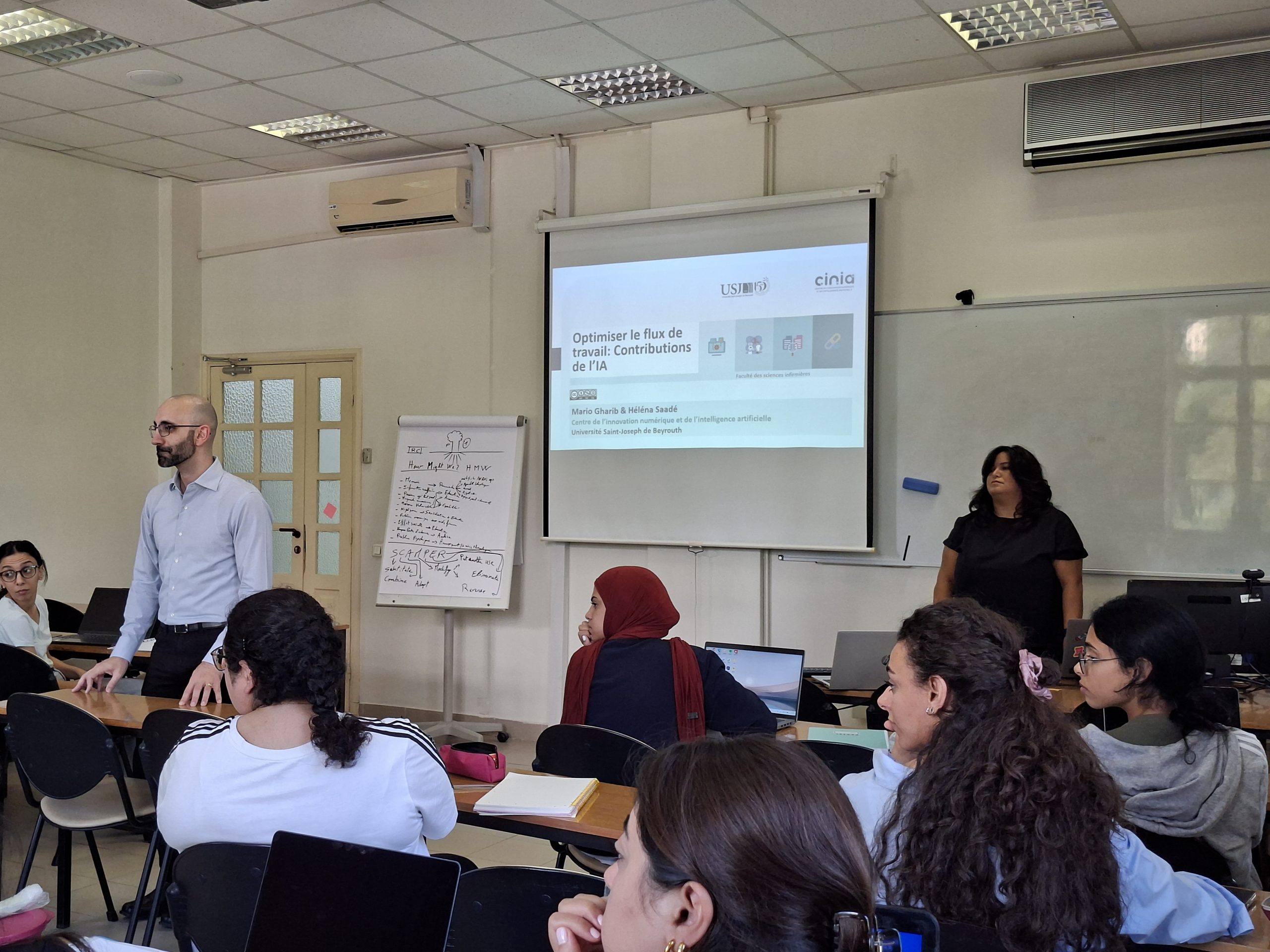
Organisée le vendredi 25 septembre 2026, de 13h30 à 15h30, la formation s’est adressée à un groupe de 15 étudiantes-chercheuses et s’inscrit dans la volonté de la Faculté d’accompagner ses étudiantes dans l’évolution des pratiques de recherche scientifique à l’ère de l’intelligence artificielle.
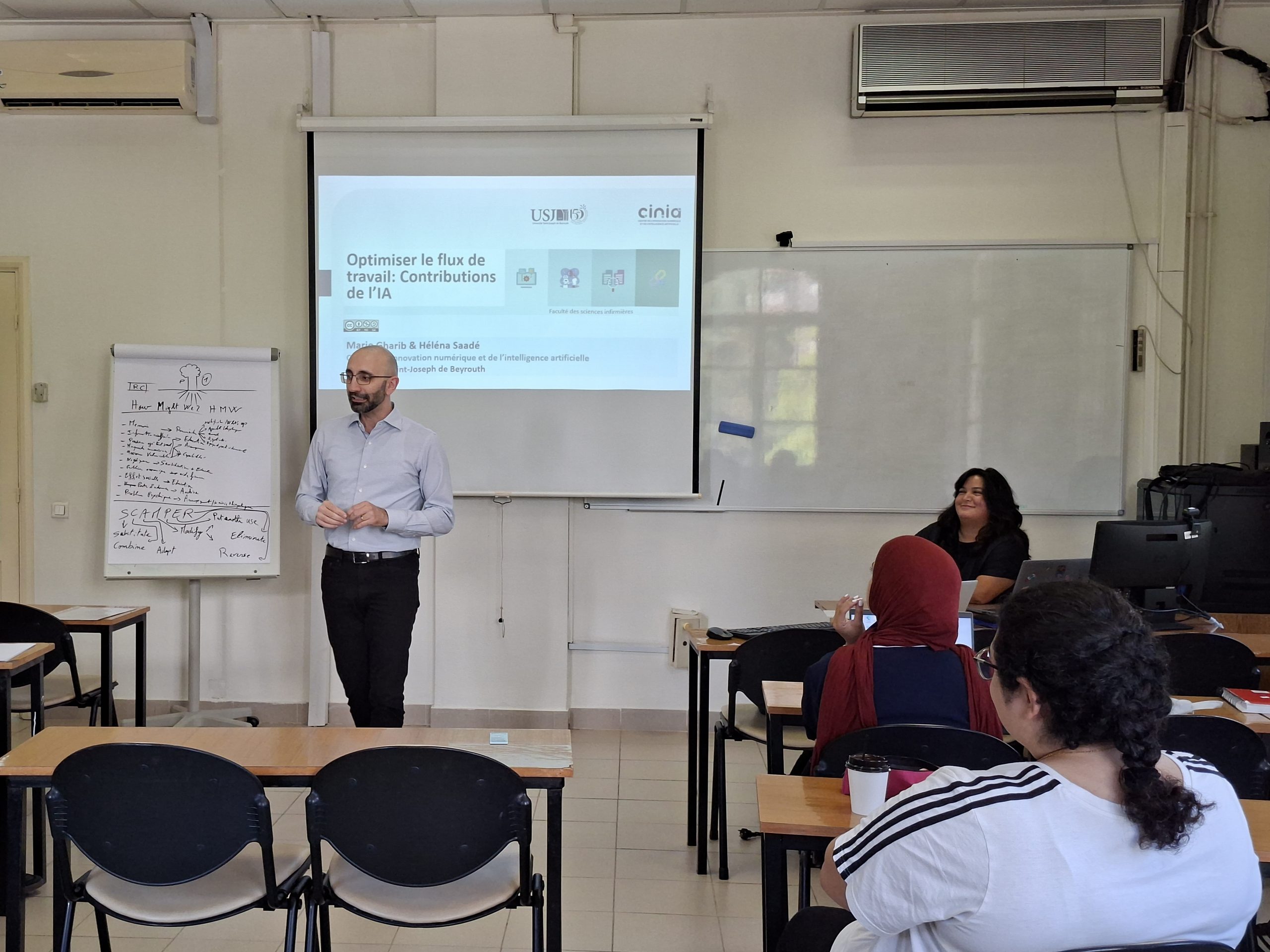
La séance a été introduite par M. Mario Gharib, Team Leader au CINIA, qui a mis l’accent sur les transformations que connaît aujourd’hui le monde académique avec l’émergence rapide des outils d’intelligence artificielle et sur la nécessité de développer les compétences permettant de les intégrer de manière pertinente dans les pratiques universitaires.
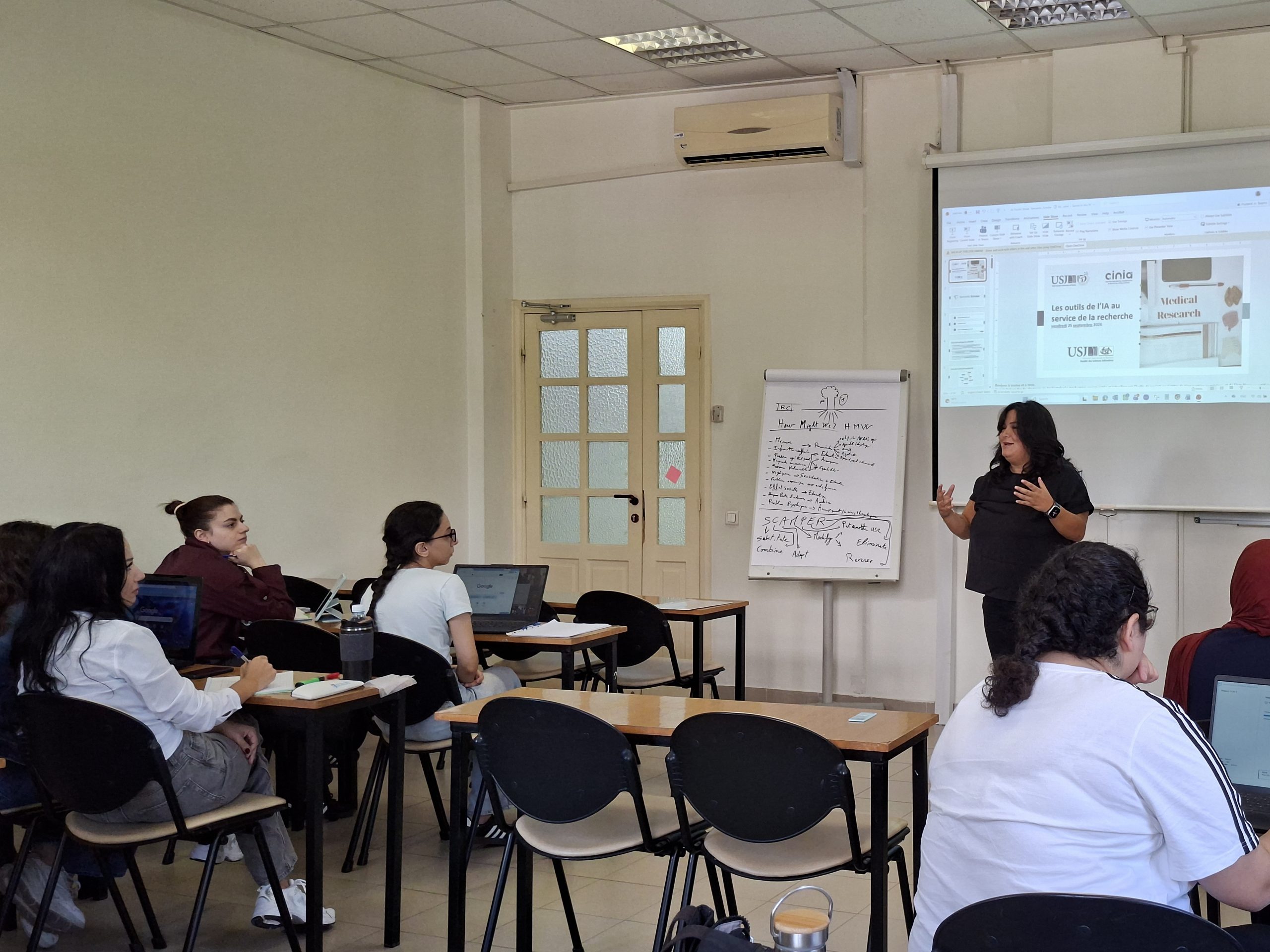
La formation a ensuite été assurée par Dr Helena Saade, Cheffe de projets au CINIA, autour du thème « Les outils de l’IA au service de la recherche ». À travers une approche à la fois théorique et pratique, les participantes ont découvert trois outils susceptibles d’accompagner différentes étapes d’une démarche de recherche et, plus particulièrement, de la revue de littérature : Semantic Scholar, Paperguide et Litmaps.
La présentation a permis de montrer que ces outils, loin d’être interchangeables, répondent à des besoins complémentaires. Semantic Scholar a été présenté comme un moteur de recherche académique exploitant l’intelligence artificielle pour faciliter l’identification de publications scientifiques pertinentes et influentes. Paperguide a permis d’explorer les possibilités offertes par l’IA pour rechercher, analyser et synthétiser des contenus académiques, organiser les références, extraire des données et accompagner certaines étapes de la rédaction scientifique. Litmaps a, quant à lui, illustré une autre dimension de la recherche documentaire : la cartographie de la littérature scientifique et la visualisation des relations entre les publications à travers les réseaux de citations.
Des démonstrations pratiques ont permis aux étudiantes de comprendre comment intégrer ces outils à leur propre démarche de recherche : identifier des articles pertinents, remonter vers les travaux fondateurs d’un domaine, découvrir des publications plus récentes, explorer les liens entre différents travaux, organiser une revue de littérature ou encore faciliter l’analyse et la comparaison d’un ensemble de références scientifiques.
Au-delà de la découverte des fonctionnalités, une attention particulière a été accordée aux limites de ces outils et à la nécessité de conserver une posture critique. Cette réflexion a constitué le fil conducteur de la formation : l’intelligence artificielle doit être envisagée comme un outil d’accompagnement du chercheur et non comme un substitut à sa réflexion. Si elle peut contribuer à accélérer certaines étapes de la recherche, à mieux structurer l’information et à faciliter l’exploration d’une littérature scientifique de plus en plus abondante, son utilisation doit rester encadrée par les principes fondamentaux de rigueur scientifique, de transparence, d’intégrité académique et de responsabilité.
En conclusion de la séance, M. Mario Gharib a invité les étudiantes-chercheuses à tirer profit des possibilités offertes par ces nouvelles technologies tout en maintenant une vigilance constante quant à leurs usages. Il les a encouragées à adopter une utilisation éthique et responsable de l’intelligence artificielle, fondée sur la vérification des informations, la transparence quant au recours aux outils d’IA et le respect des exigences propres à la recherche scientifique et académique.
À travers cette intervention, le CINIA poursuit sa mission d’accompagnement de la communauté universitaire de l’USJ dans l’appropriation raisonnée des technologies émergentes. En collaborant avec les facultés et en intervenant directement auprès des enseignants, chercheurs et étudiants, le Centre contribue au développement d’une culture de l’intelligence artificielle qui conjugue innovation, esprit critique, éthique et responsabilité.
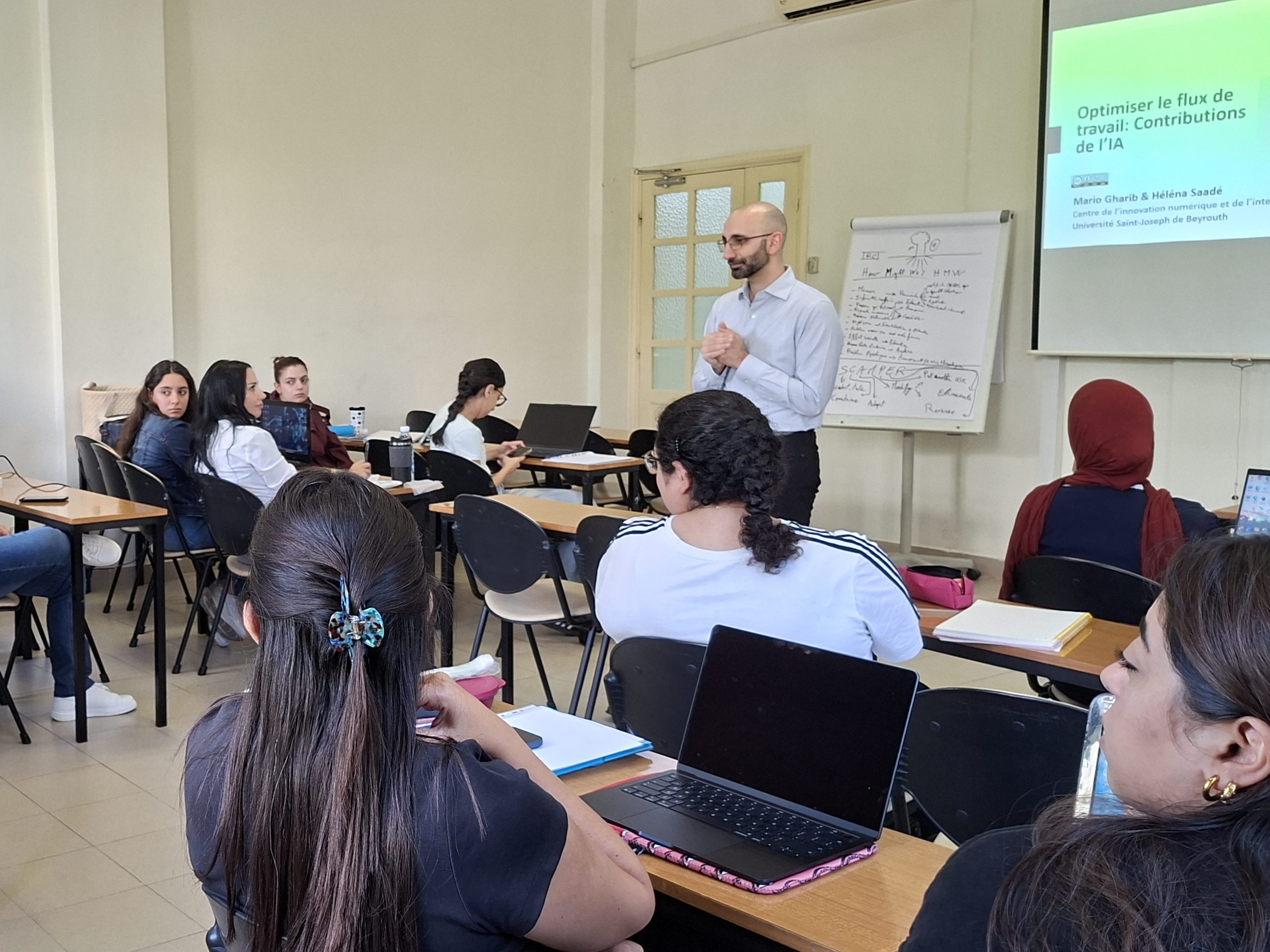
As part of the “Critical Review of the Literature” course taught by Professors Mariana Abi Aad and Pauline Merheb at the Faculty of Nursing Sciences (FSI) of Saint Joseph University of Beirut, the Center for Digital Innovation and Artificial Intelligence (CINIA) team was invited to deliver a training session focusing on artificial intelligence tools applied to research, as well as their ethical and responsible use.
Held on Friday, September 25, 2026, from 1:30 p.m. to 3:30 p.m., the training session brought together a group of 15 student researchers and reflected the Faculty’s commitment to supporting its students as scientific research practices continue to evolve in the age of artificial intelligence.
The session was introduced by Mr. Mario Gharib, Team Leader at CINIA, who highlighted the transformations currently reshaping academia with the rapid emergence of artificial intelligence tools, as well as the need to develop the skills required to integrate these tools effectively and appropriately into academic practices.
The training was then delivered by Dr. Helena Saade, Project Manager at CINIA, under the theme “AI Tools for Research.” Combining theoretical insights with practical applications, the participants explored three tools designed to support different stages of the research process, particularly the literature review: Semantic Scholar, Paperguide, and Litmaps.
The presentation demonstrated that, rather than being interchangeable, these tools address complementary research needs. Semantic Scholar was presented as an academic search engine that leverages artificial intelligence to facilitate the identification of relevant and influential scientific publications. Paperguide provided an opportunity to explore how AI can be used to search, analyze, and synthesize academic content, organize references, extract data, and support certain stages of academic writing. Litmaps, in turn, illustrated another dimension of literature research: mapping scientific literature and visualizing relationships among publications through citation networks.
Practical demonstrations enabled the students to understand how these tools can be integrated into their own research process: identifying relevant articles, tracing foundational studies in a particular field, discovering more recent publications, exploring connections among different studies, organizing a literature review, and facilitating the analysis and comparison of a set of scientific references.
Beyond exploring the tools’ features, particular attention was paid to their limitations and to the importance of maintaining a critical perspective. This reflection served as a guiding principle throughout the training: artificial intelligence should be viewed as a tool that supports researchers rather than as a substitute for their own critical thinking. While AI can help accelerate certain stages of the research process, improve the organization of information, and facilitate the exploration of an ever-growing body of scientific literature, its use must remain guided by the fundamental principles of scientific rigor, transparency, academic integrity, and responsibility.
At the conclusion of the session, Mr. Mario Gharib encouraged the student researchers to take advantage of the opportunities offered by these emerging technologies while remaining consistently vigilant about how they are used. He encouraged them to adopt an ethical and responsible approach to artificial intelligence, based on verifying information, being transparent about the use of AI tools, and complying with the standards and requirements of scientific and academic research.
Through this initiative, CINIA continues its mission of supporting the USJ academic community in the thoughtful and responsible adoption of emerging technologies. By collaborating with faculties and engaging directly with faculty members, researchers, and students, the Center contributes to fostering a culture of artificial intelligence that brings together innovation, critical thinking, ethics, and responsibility.
Leave a Reply Cancel reply


CINIA is located on the 7th floor of the USJ Human Sciences Campus on Damascus Street in Beirut.
Do not hesitate to contact us at cinia@usj.edu.lb
or call us on +961 1 421 000 extension 5923/5924 or on +961 1 421 094
© 2026 Center for Digital Innovation and AI. Created for free using WordPress and Kubio


No responses yet