

© 2026 Center for Digital Innovation and AI
L’École de traducteurs et d’interprètes de Beyrouth (ETIB) et le Centre de l’innovation numérique et de l’intelligence artificielle (CINIA) de l’Université Saint-Joseph de Beyrouth (USJ) ont présenté à Genève un projet innovant consacré à l’intégration de l’intelligence artificielle dans la formation des interprètes.
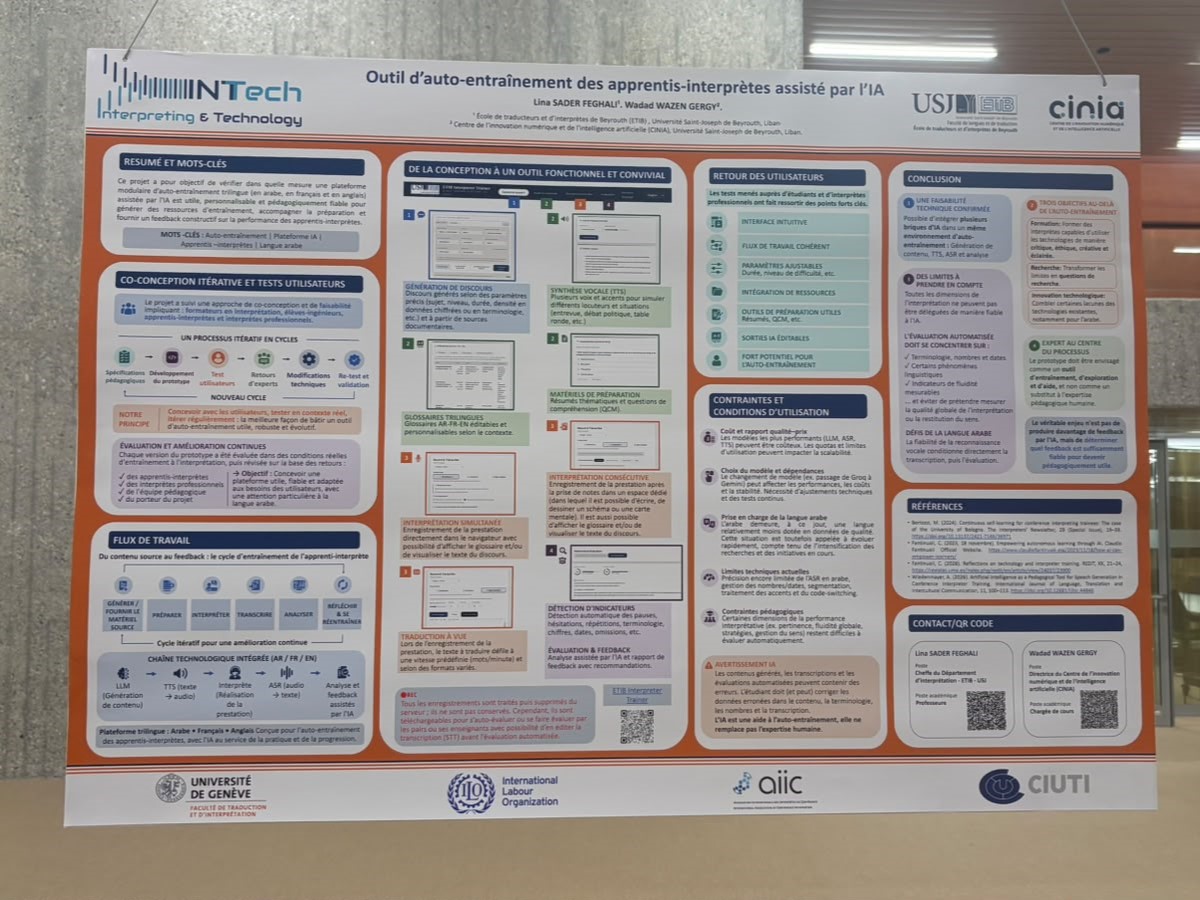
Intitulé « Outil d’auto-entraînement des apprentis-interprètes assisté par l’IA », le projet a été présenté par la Professeure Lina Sader Feghali, cheffe du Département d’interprétation à l’ETIB, et Madame Wadad Wazen Gergy, directrice du CINIA, dans le cadre de la conférence internationale « 100 Years of Technology in Conference Interpreting (INTTECH100) », qui s’est tenue les 1er et 2 octobre 2026 à Genève, à l’initiative de la Faculté de traduction et d’interprétation (FTI) de l’Université de Genève et de l’Organisation internationale du Travail (OIT). La contribution de l’USJ avait été retenue à l’issue d’un processus d’évaluation par les pairs.
Cette participation s’inscrit dans une réflexion plus large menée par l’ETIB autour de l’évolution de la formation à l’interprétation. Face aux transformations induites par l’intelligence artificielle dans les métiers de la traduction et de l’interprétation, l’enjeu n’est pas de substituer la technologie à l’expertise humaine, mais de former de futurs professionnels capables de l’utiliser de manière critique, éthique, créative et efficace.
Fruit d’une collaboration interdisciplinaire entre l’ETIB, le CINIA et l’École supérieure d’ingénieurs de Beyrouth (ESIB), l’ETIB Interpreter Trainer est une plateforme trilingue arabe–français–anglais qui intègre plusieurs technologies d’intelligence artificielle au sein d’un même environnement d’auto-entraînement.
Le prototype permet notamment de générer des discours selon différents sujets, niveaux de difficulté et paramètres, de créer des glossaires trilingues et des ressources de préparation, et de s’entraîner à différentes modalités d’interprétation. L’apprenti-interprète évolue ainsi dans un cycle complet : préparer, interpréter, transcrire, analyser, réfléchir et se réentraîner.
Une attention particulière a été accordée à la langue arabe, encore relativement moins dotée en données de qualité et qui présente des défis spécifiques pour les technologies de reconnaissance vocale, notamment en matière de transcription, de traitement des nombres et des dates, des accents et du code-switching. Le projet transforme ainsi certaines limites actuelles de l’IA en véritables pistes de recherche et d’innovation, tout en maintenant l’expertise humaine au cœur du processus pédagogique.
Présentée devant une communauté internationale d’interprètes professionnels, de formateurs et de chercheurs, la plateforme a été très favorablement accueillie. Les échanges suscités par la présentation ont également ouvert de nouvelles perspectives de recherche et de collaboration internationale.
Des discussions avec le LUTIN Userlab, à la Cité des Sciences et de l’Industrie à Paris, ont notamment porté sur une possible intégration de la plateforme CALIPSO. Celle-ci permettrait d’étudier de manière synchronisée le comportement des interprètes à travers différentes données oculométriques, physiologiques et linguistiques, afin d’explorer des phénomènes tels que la charge cognitive, l’attention et la confiance dans les interactions humain–IA en contexte d’interprétation.
Des échanges avec Lazaros Ouzounoglou, interprète professionnel grec et chercheur indépendant, ont par ailleurs permis d’envisager un travail sur l’affinement des paramètres de génération de la parole par l’IA à des fins didactiques, en tenant compte des difficultés propres aux différentes combinaisons linguistiques et aux différents modes d’interprétation.
La plateforme a également retenu l’attention Alicja Okoniewska, cheffe du secteur « Développement des talents » à la Direction générale de l’interprétation de la Commission européenne (DG Interpretation), qui en a souligné le potentiel et l’intérêt d’une diffusion et d’un développement plus larges.
Au-delà de la présentation d’un prototype, la participation à INTTECH100 a ainsi permis de mettre en lumière le savoir-faire développé à l’USJ à la croisée de l’interprétation, de la pédagogie, de l’ingénierie et de l’intelligence artificielle. Elle ouvre désormais la voie à de nouvelles collaborations internationales autour d’une même ambition : mettre l’IA au service de l’apprentissage, de l’autonomie et du développement professionnel des interprètes, tout en maintenant l’expertise humaine au cœur de leur formation.
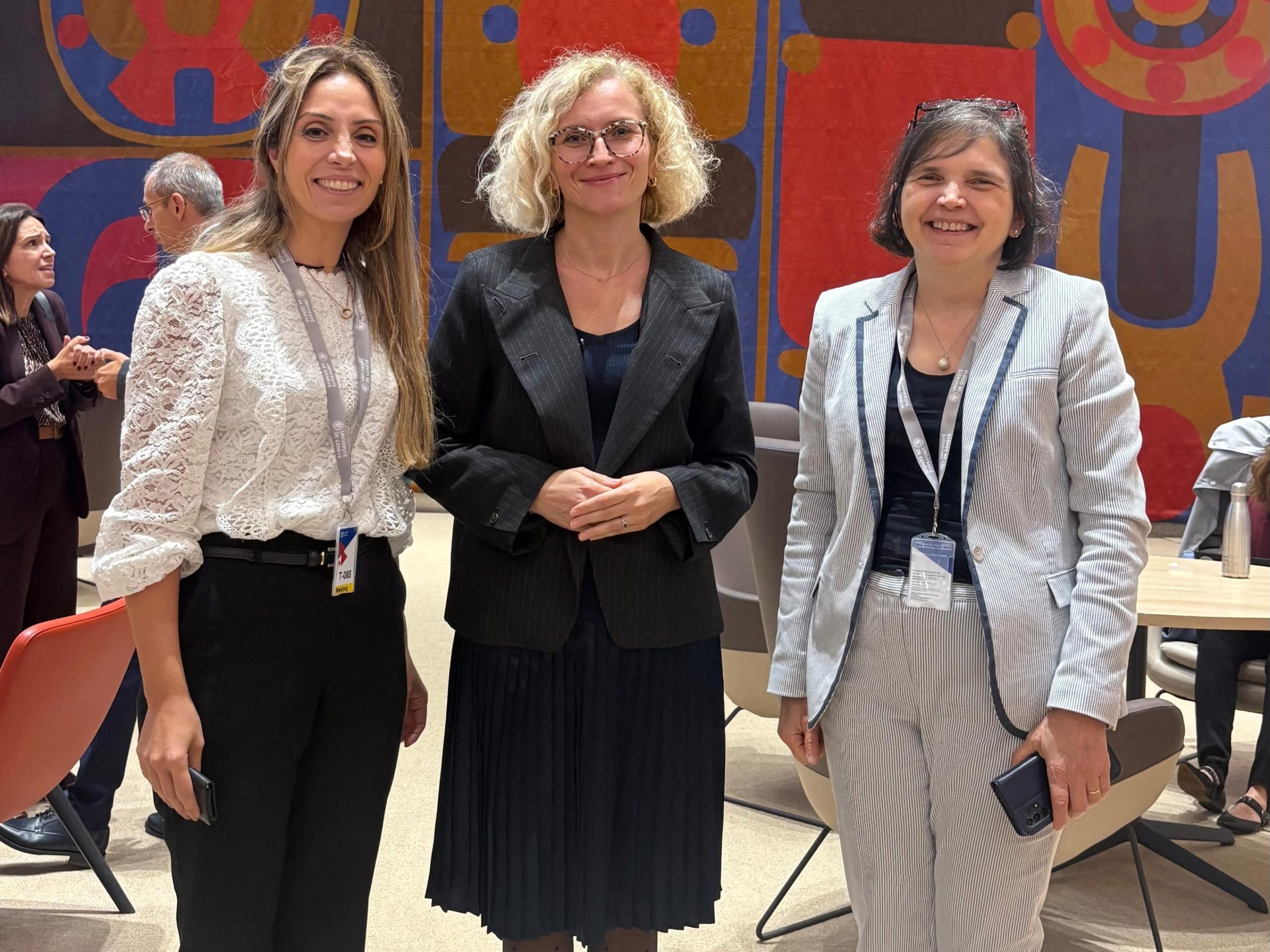
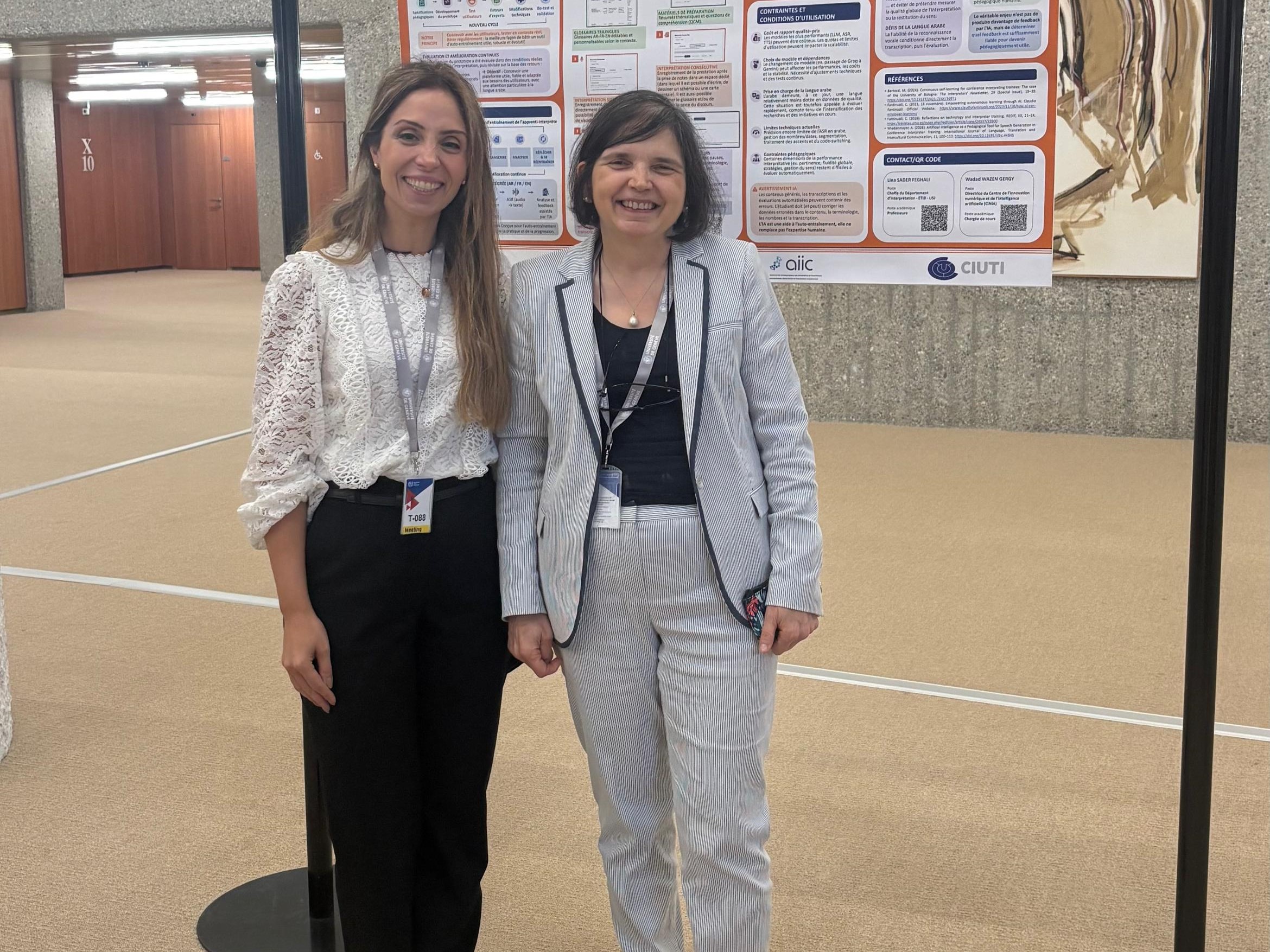
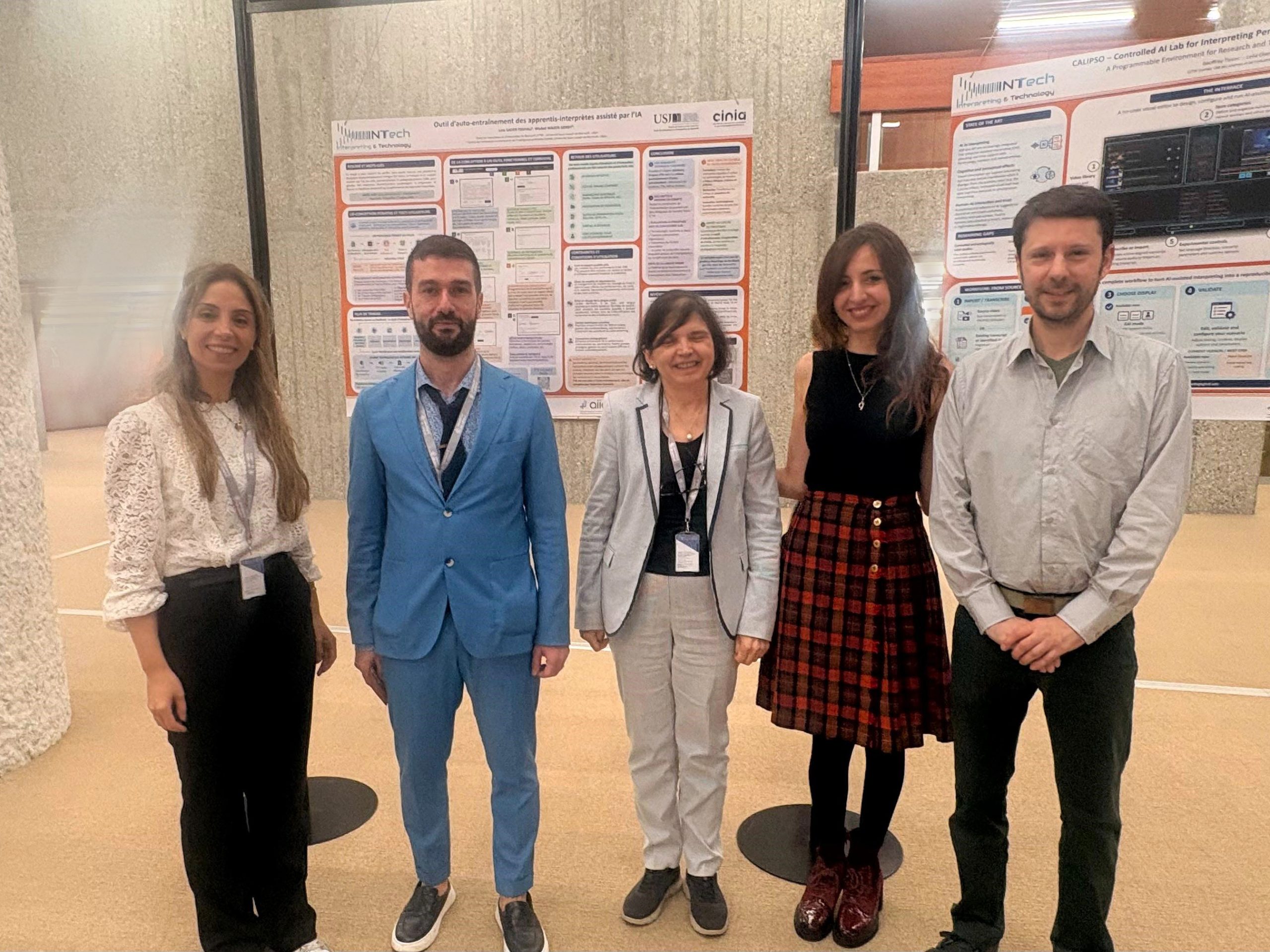
The Beirut School of Translators and Interpreters (ETIB) and the Center for Digital Innovation and Artificial Intelligence (CINIA) at Saint Joseph University of Beirut (USJ) presented an innovative project in Geneva dedicated to integrating artificial intelligence into interpreter training.
Entitled “AI-Assisted Self-Training Tool for Interpreter Trainees,” the project was presented by Professor Lina Sader Feghali, Head of the Interpreting Department at ETIB, and Mrs. Wadad Wazen Gergy, Director of CINIA, during the international conference “100 Years of Technology in Conference Interpreting (INTTECH100),” held on 1–2 October 2026 in Geneva and organized by the Faculty of Translation and Interpreting (FTI) at the University of Geneva and the International Labor Organization (ILO). USJ’s contribution had been selected following a peer-review process.
This participation formed part of ETIB’s broader reflection on the evolving landscape of interpreter training. As artificial intelligence continues to transform the translation and interpreting professions, the challenge is not to replace human expertise with technology, but rather to prepare future professionals to use these tools critically, ethically, creatively, and effectively.
Developed through an interdisciplinary collaboration between ETIB, CINIA, and the Beirut School of Engineering (ESIB), the ETIB Interpreter Trainer is a trilingual Arabic–French–English platform integrating several AI technologies within a single self-training environment.
The prototype can generate speeches based on different topics, difficulty levels, and parameters, create trilingual glossaries and preparation resources, and provide practice opportunities across different modes of interpreting. Interpreter trainees can thus work through a complete training cycle: prepare, interpret, transcribe, analyze, reflect, and retrain.
Particular attention was given to Arabic, which remains relatively under-resourced in terms of high-quality data and presents specific challenges for speech recognition technologies, particularly in transcription, the processing of numbers and dates, accents, and code-switching. The project therefore turns some of the current limitations of AI into genuine research questions and opportunities for innovation, while keeping human expertise at the heart of the pedagogical process.
Presented to an international community of professional interpreters, trainers, and researchers, the platform was warmly received. The discussions generated by the presentation also opened up promising opportunities for international research and collaboration.
Discussions with LUTIN Userlab at the City of Science and Industry in Paris explored the possible integration of the CALIPSO platform. This could enable synchronized observation of interpreter behaviour across eye-tracking, physiological, and linguistic channels to investigate phenomena such as cognitive load, attention, and trust in human–AI interaction in interpreting contexts.
Exchanges with Lazaros Ouzounoglou, a Greek professional interpreter and independent researcher, also explored opportunities to refine AI-generated speech parameters for training purposes, taking into account challenges specific to different language pairs and modes of interpreting.
The platform also attracted the attention of Alicja Okoniewska, Head of Sector for Talent Development at the European Commission’s Directorate-General for Interpretation (DG Interpretation), who recognized its potential to be shared and further developed.
Beyond presenting a prototype, USJ’s participation in INTTECH100 highlighted the expertise developed at the intersection of interpreting, pedagogy, engineering, and artificial intelligence. It now opens the way to new international collaborations around a shared ambition: harnessing AI to support learning, learner autonomy, and interpreters’ professional development while keeping human expertise at the heart of interpreter training.
Laisser un commentaire Annuler la réponse


CINIA est situé au 7ème étage du campus des sciences humaines de l’USJ, rue de Damas à Beyrouth.
N’hésitez pas à nous contacter à cinia@usj.edu.lb
ou à nous appeler au +961 1 421 000 poste 5923/5924 ou au +961 1 421 094
© 2026 Center for Digital Innovation and AI. Created for free using WordPress and Kubio


No responses yet